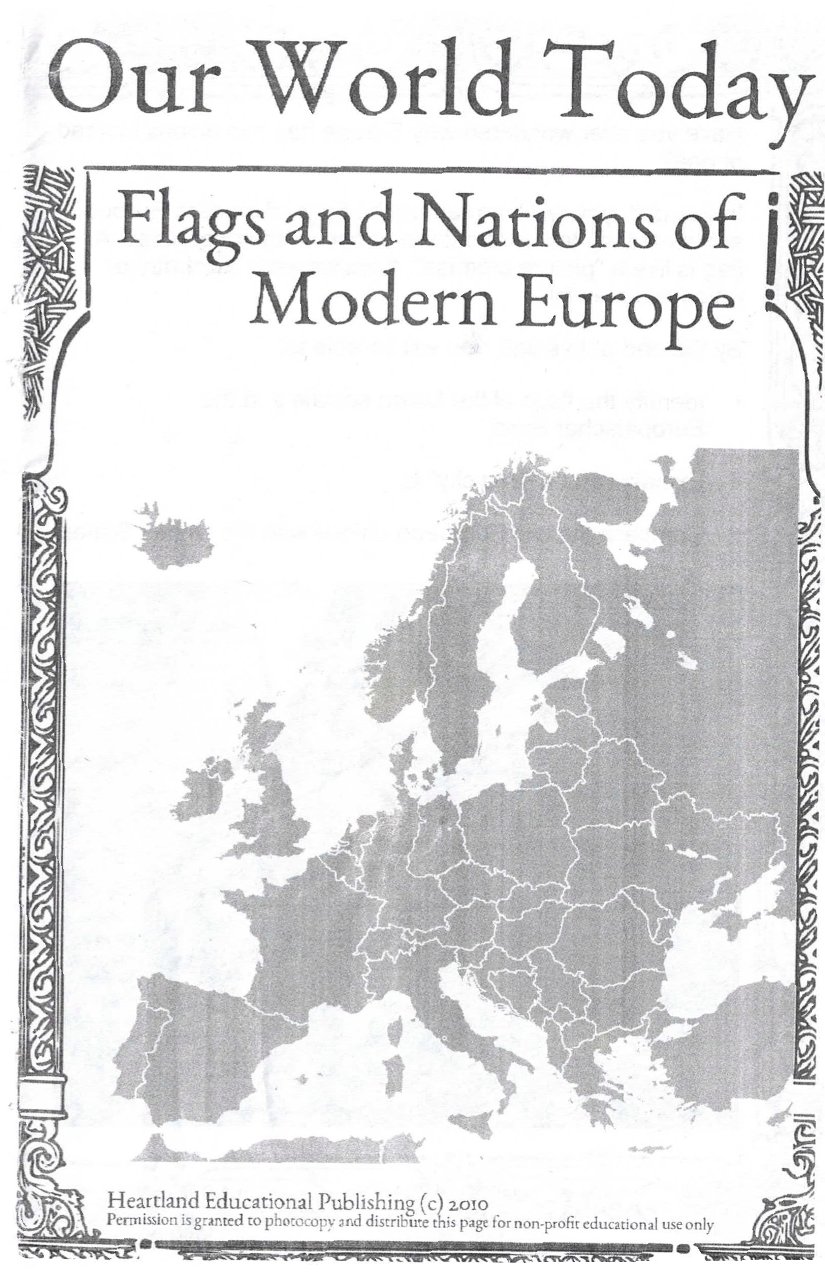
Our World Today: Flags and Nations of Modern Europe
| no. | 001 |
|---|---|
| date | September 2010 |
| kind | facsimile |
| author | Heartland Educational Publishing |
| polities | Union sociale, Europäischer Bund, France, Federal Republic, German Democratic Republic, Deutscher Freistaat, Volksstadt Berlin, United Kingdom, Italy, Spain (republic), Portugal |
Transcription
Cover: Our World Today — Flags and Nations of Modern Europe. Heartland Educational Publishing © 2010. Permission is granted to photocopy and distribute this page for non-profit educational use only.
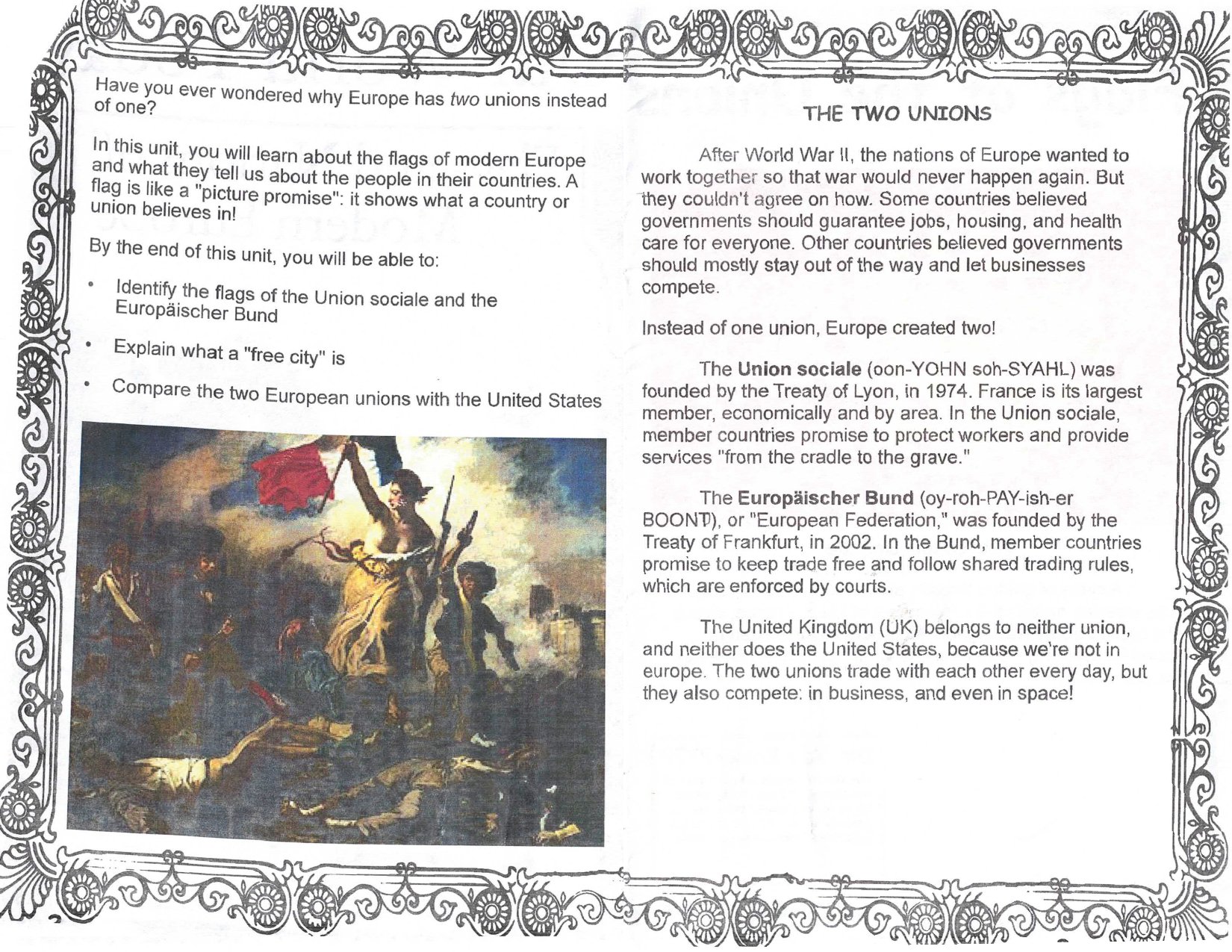
Have you ever wondered why Europe has two unions instead of one?
In this unit, you will learn about the flags of modern Europe and what they tell us about the people in their countries. A flag is like a “picture promise”: it shows what a country or union believes in!
By the end of this unit, you will be able to: identify the flags of the Union sociale and the Europäischer Bund; explain what a “free city” is; compare the two European unions with the United States.
The Two Unions. After World War II, the nations of Europe wanted to work together so that war would never happen again. But they couldn’t agree on how. Some countries believed governments should guarantee jobs, housing, and health care for everyone. Other countries believed governments should mostly stay out of the way and let businesses compete. Instead of one union, Europe created two!
The Union sociale (oon-YOHN soh-SYAHL) was founded by the Treaty of Lyon, in 1974. France is its largest member, economically and by area. In the Union sociale, member countries promise to protect workers and provide services “from the cradle to the grave.”
The Europäischer Bund (oy-roh-PAY-ish-er BOONT), or “European Federation,” was founded by the Treaty of Frankfurt, in 2002. In the Bund, member countries promise to keep trade free and follow shared trading rules, which are enforced by courts.
The United Kingdom (UK) belongs to neither union, and neither does the United States, because we’re not in europe. The two unions trade with each other every day, but they also compete: in business, and even in space!
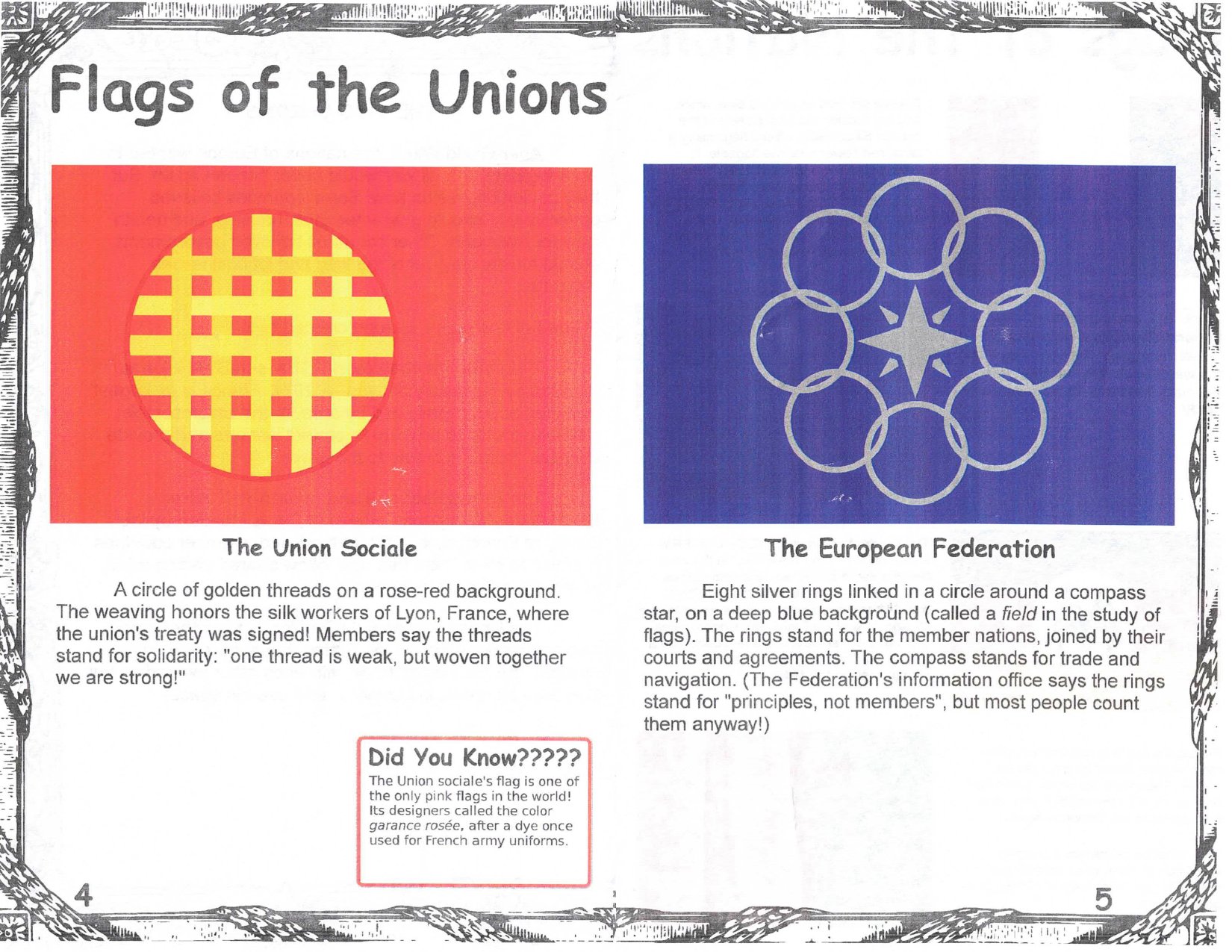
Flags of the Unions. The Union Sociale: a circle of golden threads on a rose-red background. The weaving honors the silk workers of Lyon, France, where the union’s treaty was signed! Members say the threads stand for solidarity: “one thread is weak, but woven together we are strong!” Did you know? The Union sociale’s flag is one of the only pink flags in the world! Its designers called the color garance rosée, after a dye once used for French army uniforms.
The European Federation: eight silver rings linked in a circle around a compass star, on a deep blue background (called a field in the study of flags). The rings stand for the member nations, joined by their courts and agreements. The compass stands for trade and navigation. (The Federation’s information office says the rings stand for “principles, not members”, but most people count them anyway!)
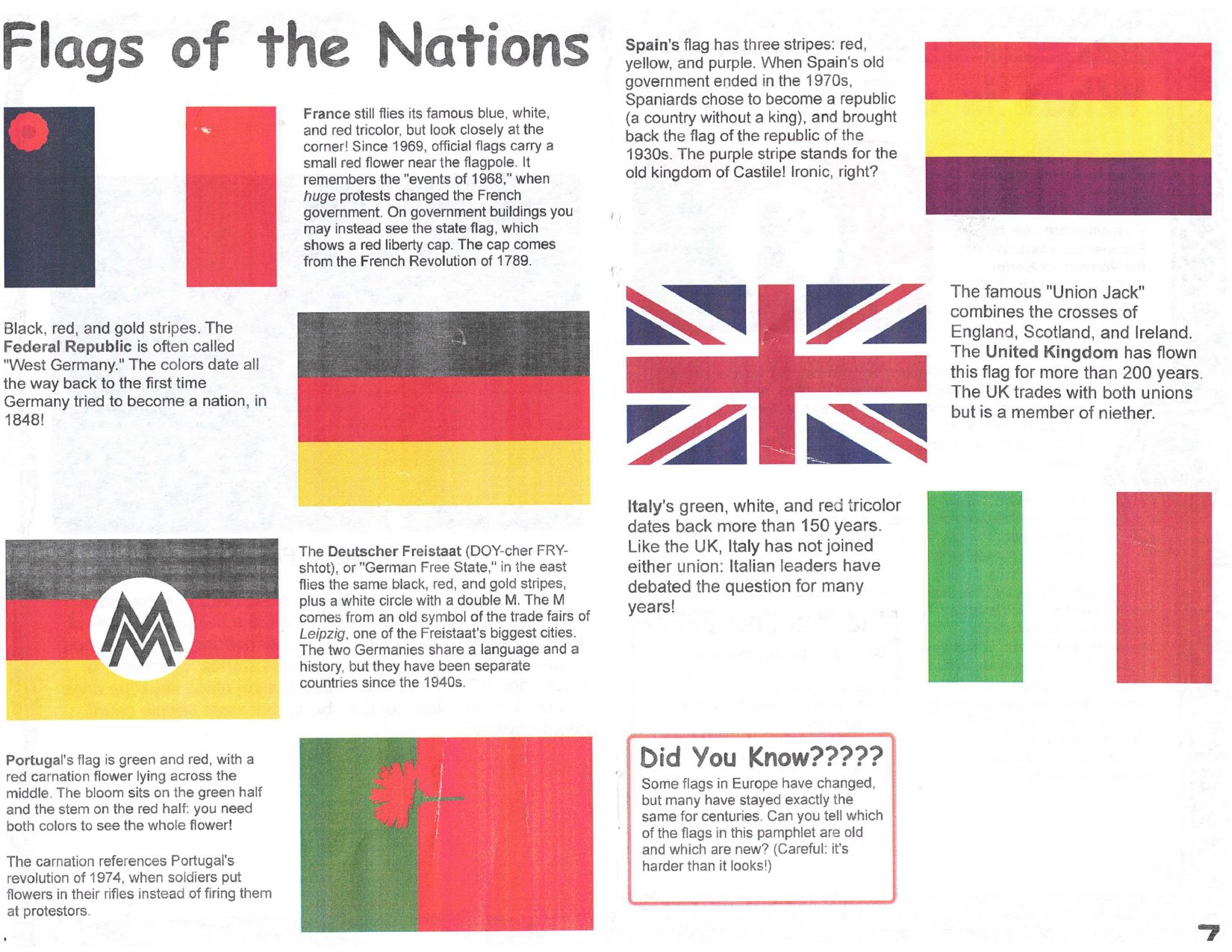
Flags of the Nations. France still flies its famous blue, white, and red tricolor, but look closely at the corner! Since 1969, official flags carry a small red flower near the flagpole. It remembers the “events of 1968,” when huge protests changed the French government. On government buildings you may instead see the state flag, which shows a red liberty cap. The cap comes from the French Revolution of 1789.
Black, red, and gold stripes: the Federal Republic is often called “West Germany.” The colors date all the way back to the first time Germany tried to become a nation, in 1848! The Deutscher Freistaat (DOY-cher FRY-shtot), or “German Free State,” in the east flies the same black, red, and gold stripes, plus a white circle with a double M. The M comes from an old symbol of the trade fairs of Leipzig, one of the Freistaat’s biggest cities. The two Germanies share a language and a history, but they have been separate countries since the 1940s.
Spain’s flag has three stripes: red, yellow, and purple. When Spain’s old government ended in the 1970s, Spaniards chose to become a republic (a country without a king), and brought back the flag of the republic of the 1930s. The purple stripe stands for the old kingdom of Castile! Ironic, right?
The famous “Union Jack” combines the crosses of England, Scotland, and Ireland. The United Kingdom has flown this flag for more than 200 years. The UK trades with both unions but is a member of niether.
Italy’s green, white, and red tricolor dates back more than 150 years. Like the UK, Italy has not joined either union: Italian leaders have debated the question for many years!
Portugal’s flag is green and red, with a red carnation flower lying across the middle. The bloom sits on the green half and the stem on the red half: you need both colors to see the whole flower! The carnation references Portugal’s revolution of 1974, when soldiers put flowers in their rifles instead of firing them at protestors.
Did you know? Some flags in Europe have changed, but many have stayed exactly the same for centuries. Can you tell which of the flags in this pamphlet are old and which are new? (Careful: it’s harder than it looks!)
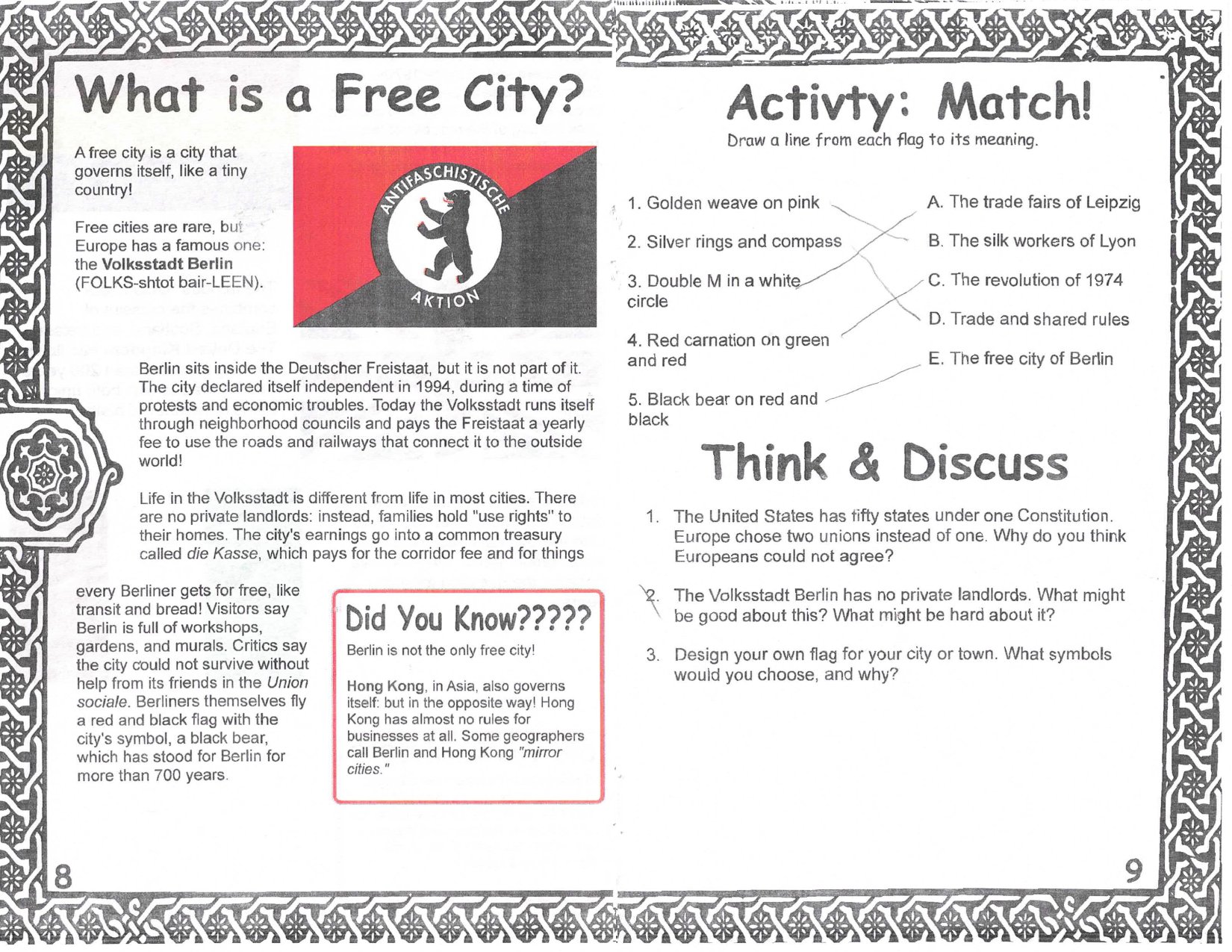
What is a Free City? A free city is a city that governs itself, like a tiny country! Free cities are rare, but Europe has a famous one: the Volksstadt Berlin (FOLKS-shtot bair-LEEN). Berlin sits inside the Deutscher Freistaat, but it is not part of it. The city declared itself independent in 1994, during a time of protests and economic troubles. Today the Volksstadt runs itself through neighborhood councils and pays the Freistaat a yearly fee to use the roads and railways that connect it to the outside world!
Life in the Volksstadt is different from life in most cities. There are no private landlords: instead, families hold “use rights” to their homes. The city’s earnings go into a common treasury called die Kasse, which pays for the corridor fee and for things every Berliner gets for free, like transit and bread! Visitors say Berlin is full of workshops, gardens, and murals. Critics say the city could not survive without help from its friends in the Union sociale. Berliners themselves fly a red and black flag with the city’s symbol, a black bear, which has stood for Berlin for more than 700 years.
Did you know? Berlin is not the only free city! Hong Kong, in Asia, also governs itself: but in the opposite way! Hong Kong has almost no rules for businesses at all. Some geographers call Berlin and Hong Kong “mirror cities.”
Activity: Match! Draw a line from each flag to its meaning. 1. Golden weave on pink — 2. Silver rings and compass — 3. Double M in a white circle — 4. Red carnation on green and red — 5. Black bear on red and black. A. The trade fairs of Leipzig — B. The silk workers of Lyon — C. The revolution of 1974 — D. Trade and shared rules — E. The free city of Berlin.
Think & Discuss. 1. The United States has fifty states under one Constitution. Europe chose two unions instead of one. Why do you think Europeans could not agree? 2. The Volksstadt Berlin has no private landlords. What might be good about this? What might be hard about this? 3. Design your own flag for your city or town. What symbols would you choose, and why?
Back page, in pencil: “ask before Q2 — some kids have family in NOLA — district memo on 9/7”
Back page, printed: © 2010 Heartland Educational Publishing. Aligned to state social studies standards. Visit our website for full-color flag posters and answer keys.